E-commerce Chatbot Cost and ROI Guide
Do not ask what the chatbot costs. Ask what it pays back.
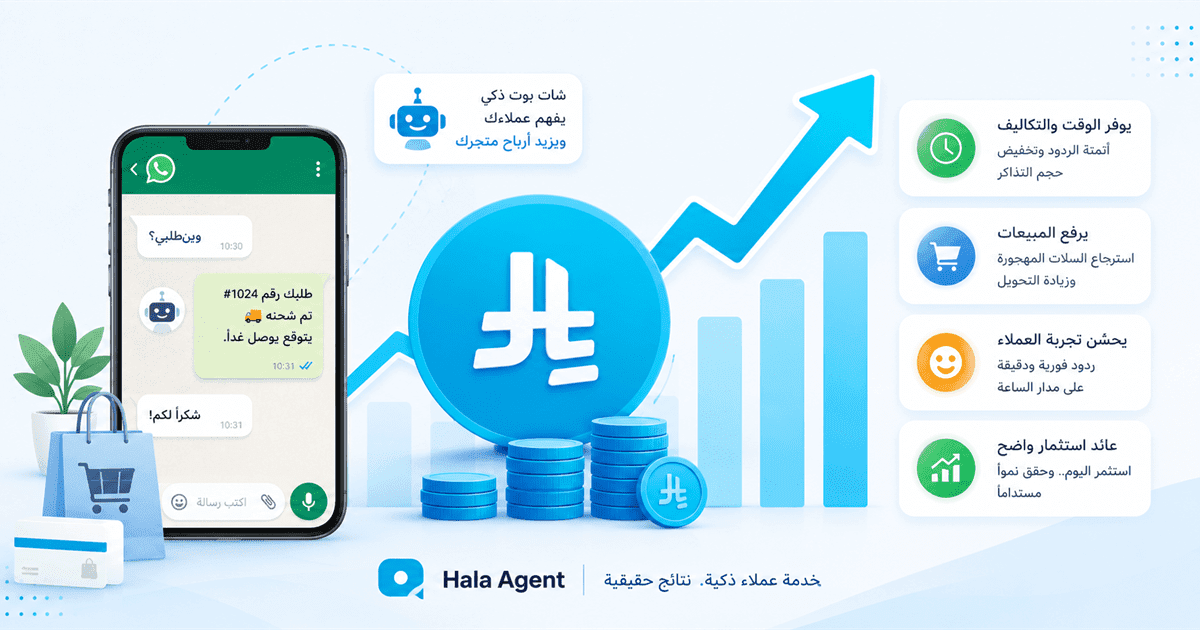
Customer service chatbot cost is not just a monthly plan. The real number includes the platform subscription, WhatsApp API usage, setup work, store integration, knowledge-base cleanup, QA, and sometimes provider fees. The smarter question is: will it save enough support time and create enough gross profit to justify the monthly cost?
A cheap bot that cannot understand customers, read policies, or escalate to a human can create more work than it removes. A stronger AI support platform may be worth the higher price if it safely deflects repeat questions, answers order-aware queries, and helps recover abandoned carts.
For the bigger support strategy, start with the Arabic AI customer service guide for Saudi ecommerce stores. This guide focuses on the numbers: how to calculate ecommerce chatbot ROI before you buy.
What goes into ecommerce chatbot cost?
Think in total monthly ownership cost, not subscription price:
| Cost bucket | What it means | Question to ask |
|---|---|---|
| Chatbot subscription | Monthly fee by channel, store, conversation, or usage | Does it include web chat, WhatsApp, and Instagram? |
| WhatsApp API cost | Meta charges plus provider or platform fees | Are Meta fees included or passed through? |
| Setup and integration | Connecting Salla, Zid, Shopify, products, orders, and policies | Does setup include order and catalog sync? |
| Knowledge preparation | FAQs, shipping, returns, product details, and tone | Does the bot answer from store data? |
| QA and optimization | Reviewing transcripts and improving answers | Do reports show deflection and escalation? |
| Privacy and governance | Customer data, order data, and access controls | Where is data stored and who can access it? |
WhatsApp needs special attention. Meta says WhatsApp Business Platform pricing is per delivered message and varies by market and category: marketing, utility, authentication, and service. Meta also says service messages inside the customer-service window are free, and some entry points can make business messages free for 72 hours. Source: WhatsApp Business Platform Pricing. Twilio documented Meta’s July 1, 2025 shift from 24-hour conversation pricing to pricing per delivered template message for relevant template categories. Source: Twilio.
So do not copy a fixed WhatsApp API rate from an old calculator. Your cost depends on country, currency, message category, volume tiers, provider fees, and whether the message is customer-initiated or business-initiated.
The simple ecommerce chatbot ROI formula
Monthly ROI value = support cost saved + incremental gross profit from recovered carts - total monthly chatbot cost

Monthly ROI % = monthly ROI value ÷ total monthly chatbot cost × 100
Inputs:
Saved support hours = monthly support questions × automation rate × manual minutes per question ÷ 60

Support cost saved = saved support hours × loaded hourly support cost

Recovered cart gross profit = abandoned carts × incremental recovery rate × average order value × gross margin

Total monthly chatbot cost = platform subscription + WhatsApp/Meta/provider usage + amortized setup + internal review time
Stay conservative. Do not assume the bot will automate every conversation. Start with repeat questions: “Where is my order?”, “How long does shipping take?”, “Can I exchange this?”, “Is this product available?”, and “How do I use the discount code?”
Calculate support-hour savings first
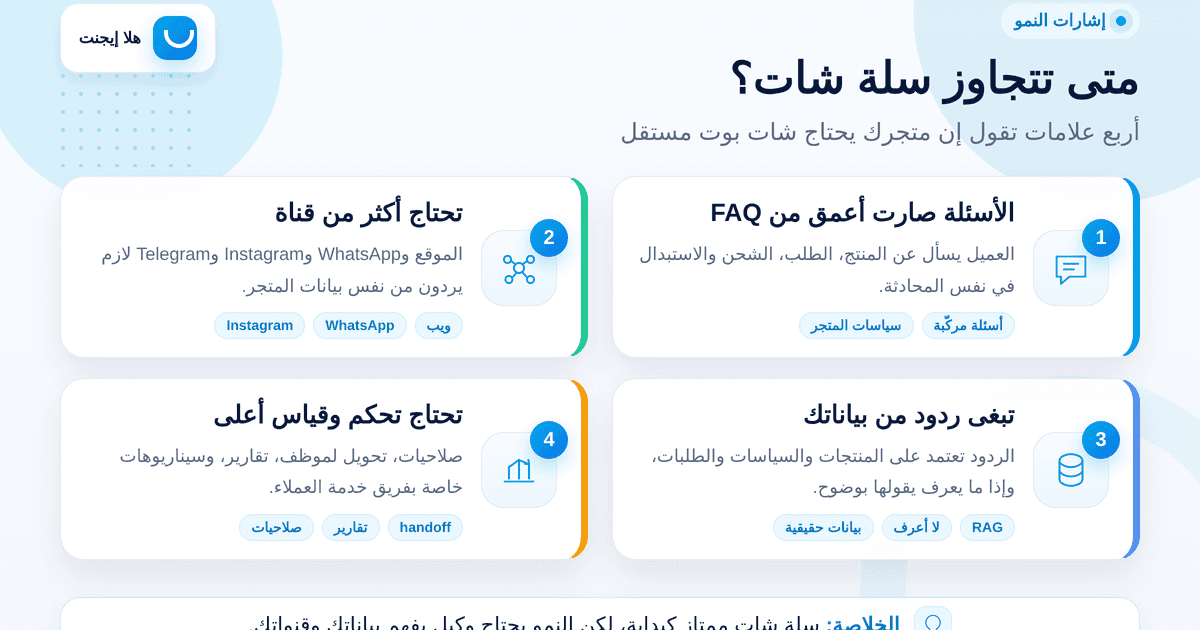
The most reliable ROI bucket is time. A good chatbot does not necessarily remove your support team; it removes repetitive work so humans can focus on delivery issues, angry customers, VIP orders, and sensitive exchanges.
Example:
- Monthly support questions: 3,000.
- Safe automation rate: 55%.
- Manual reply time: 3 minutes per question.
- Loaded monthly support cost: SAR 4,500.
- Working hours used for the calculation: 176 hours per month.
Hourly cost = 4,500 ÷ 176 = SAR 25.6
Saved hours = 3,000 × 55% × 3 ÷ 60 = 82.5 hours
Support cost saved = 82.5 × 25.6 = about SAR 2,112 per month
This is not always immediate cash savings. It is recovered operating capacity. It becomes more cash-like when your team is overloaded, reply time is hurting conversion, or you are close to hiring another agent.
Add abandoned-cart recovery carefully
Cart recovery can make ROI stronger, but only if you model incremental profit. Baymard’s benchmark shows an average documented cart abandonment rate of 70.22% based on 50 ecommerce studies. Source: Baymard. That is a global benchmark, not a guarantee for your store.
For Salla stores, Salla describes WhatsApp notifications in Salla Chat, including order and abandoned-cart notifications. Salla’s developer docs also expose abandoned-cart data that can help customers continue the purchase. Source: Salla Help and Salla Docs. For implementation, read the Arabic guide to recovering abandoned carts via WhatsApp.
Use an incremental recovery rate, such as an extra 1% to 2% of abandoned carts recovered, then replace the assumption with real data after launch.
A worked ROI example in Saudi Riyals
Assume a Saudi perfume store on Salla has these inputs:
| Input | Assumption |
|---|---|
| Monthly support questions | 3,000 |
| Conservative automation rate | 55% |
| Manual reply time | 3 minutes |
| Loaded hourly support cost | SAR 25.6 |
| Abandoned carts per month | 1,200 |
| Average order value | SAR 180 |
| Gross margin | 45% |
| Incremental cart recovery | 1.5% |
| Chatbot subscription | SAR 1,200 |
| WhatsApp/Meta/provider usage | SAR 350 |
| Setup amortized over 6 months | SAR 500 |
| Internal review time | SAR 300 |
Support cost saved = SAR 2,112
Extra recovered orders = 1,200 × 1.5% = 18 orders
Recovered-cart gross profit = 18 × 180 × 45% = SAR 1,458
Total monthly benefit = 2,112 + 1,458 = SAR 3,570
Total monthly cost = 1,200 + 350 + 500 + 300 = SAR 2,350
Net monthly ROI value = 3,570 - 2,350 = SAR 1,220
Monthly ROI % = 1,220 ÷ 2,350 = about 52%
This example is positive, but it is not a promise. Low support volume, thin margins, or expensive untargeted WhatsApp campaigns can reduce ROI. Heavy repeat-question volume can increase it.
When is a chatbot worth it?
A chatbot is usually worth it when three things are true: you have repeated support volume, the bot answers from reliable store knowledge, and it works in channels customers actually use, such as WhatsApp, your website, or Instagram.
It is not worth it when the store is too early, policies are unclear, product data is messy, or the merchant expects automation to fix a weak offer. Automation scales a clear operation; it does not replace one.
For WhatsApp-only automation, see the Arabic Salla WhatsApp auto-reply guide. For full support ROI, calculate the whole support stack, not just message automation.
Where Hala Agent fits
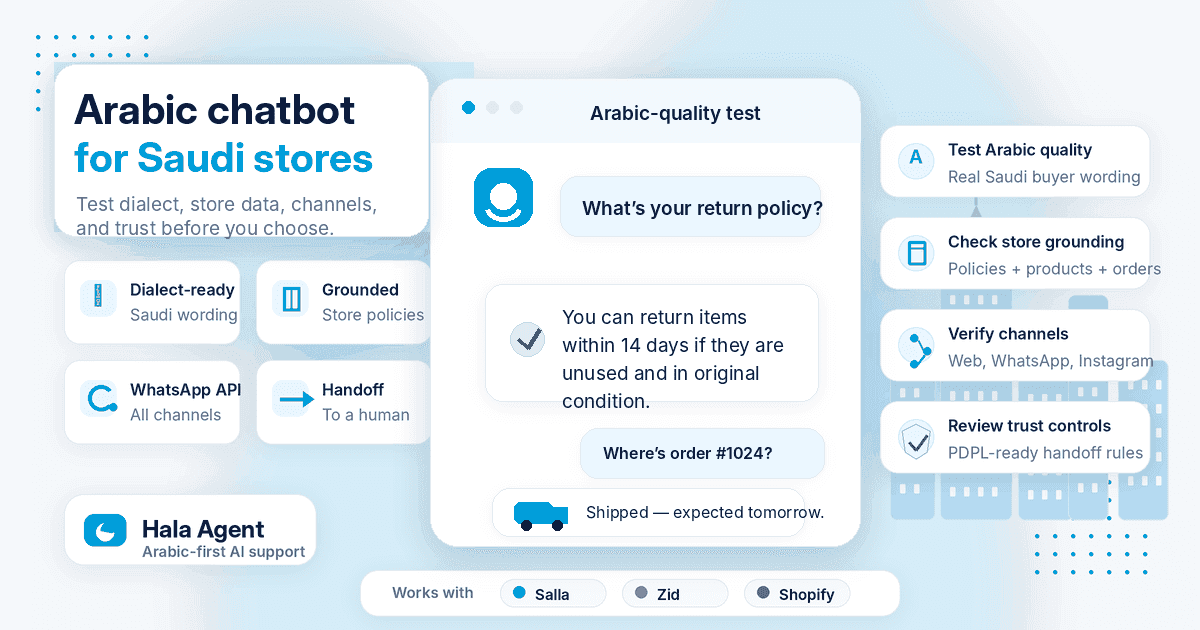
Hala Agent is built for stores that need an Arabic-first AI support agent grounded in configured products, policies, and documents. It works across website chat, WhatsApp, Telegram, and Instagram DMs; connected Salla stores can also enable catalog sync.
The intended behavior is to say “I do not know” when configured knowledge does not support an answer. Do not assume savings or an automation rate before a measured pilot. Native Zid/Shopify sync, live order access, proactive triggers, and automatic human handoff are not currently available. Privacy also belongs in the buying process. General Saudi PDPL reference.
Buyer checklist before you sign
- How many support conversations do we get per month?
- What are our top 20 repeated questions?
- How many minutes does a manual reply take?
- Are shipping, returns, exchange, and COD policies written clearly?
- Can the chatbot read product, order, and policy data?
- Is WhatsApp API cost separated from the platform subscription?
- Does the dashboard show automation, escalation, and recovered-cart metrics?
- Can the bot hand off to a human without frustrating the customer?
Want to test the model against your own baseline? Start a Hala Agent trial, then compare measured results with your current workflow.
FAQ
How much does an ecommerce chatbot cost?
There is no single fair number. Cost depends on the subscription, channels, usage, store integration, WhatsApp API fees, setup, and ongoing review. Compare total monthly ownership cost, not the headline plan price.
Is WhatsApp API cost included in chatbot pricing?
Sometimes. Some platforms pass Meta and provider fees through separately; others package them as credits or bundles. Ask whether Meta charges are included, which message categories apply, and how overage is billed.
What is the quickest way to calculate customer service chatbot ROI?
Start with time saved: monthly questions × automation rate × manual minutes per question ÷ 60. Multiply by loaded hourly support cost, then add gross profit from incremental cart recovery if it applies.
Can a chatbot increase revenue, or does it only reduce support cost?
It can do both. Cost savings come from automating repeated questions. Revenue impact comes from faster replies, product guidance, cart reminders, and fewer customers dropping before checkout.
What automation rate should I use in the first model?
Use a conservative range such as 40% to 60% when questions are repetitive and policies are clear. After launch, replace assumptions with real metrics.
Is a cheap chatbot good enough?
It can be enough for a small store with simple FAQs. It is usually not enough when you need Arabic quality, order-aware answers, WhatsApp API workflows, analytics, and human handoff.
When do I need Hala Agent instead of a simple FAQ bot?
Use Hala Agent when you need Arabic answers from configured store knowledge across website chat, WhatsApp, Telegram, and Instagram DMs, with optional Salla catalog content. Use the store or carrier workflow for live orders, tracking, and staff escalation.
Sources
- https://whatsappbusiness.com/products/platform-pricing/
- https://www.twilio.com/en-us/changelog/meta-is-updating-whatsapp-pricing-on-july-1--2025
- https://baymard.com/lists/cart-abandonment-rate
- https://help.salla.sa/en/article/whatsapp-notifications-in-salla-chat/kccjhuqmichsi25ey5lzbpov
- https://docs.salla.dev/841783f0
- https://www.dlapiperdataprotection.com/?c=SA
Let Hala Agent answer customers automatically
Connect your store and WhatsApp, then let an AI support agent answer customers around the clock.
Start free