Best Arabic Chatbot for Ecommerce Stores: Saudi Buyer Guide
Contents
- Quick answer
- Why Arabic ecommerce chatbots are different in Saudi Arabia
- What the best Arabic chatbot for ecommerce should do
- Types of chatbot tools Saudi stores usually compare
- Buyer checklist before you subscribe
- Arabic quality and Saudi dialect test prompts
- Where Hala Agent fits
- FAQ
Quick answer
The best Arabic chatbot for ecommerce is not just a bot that replies in Arabic. That is the minimum. A serious choice for a Saudi online store should understand how customers actually write, answer from the store’s own data, connect with ecommerce platforms such as Salla and Zid, work on WhatsApp when needed, and hand off to a human when the answer requires judgment.
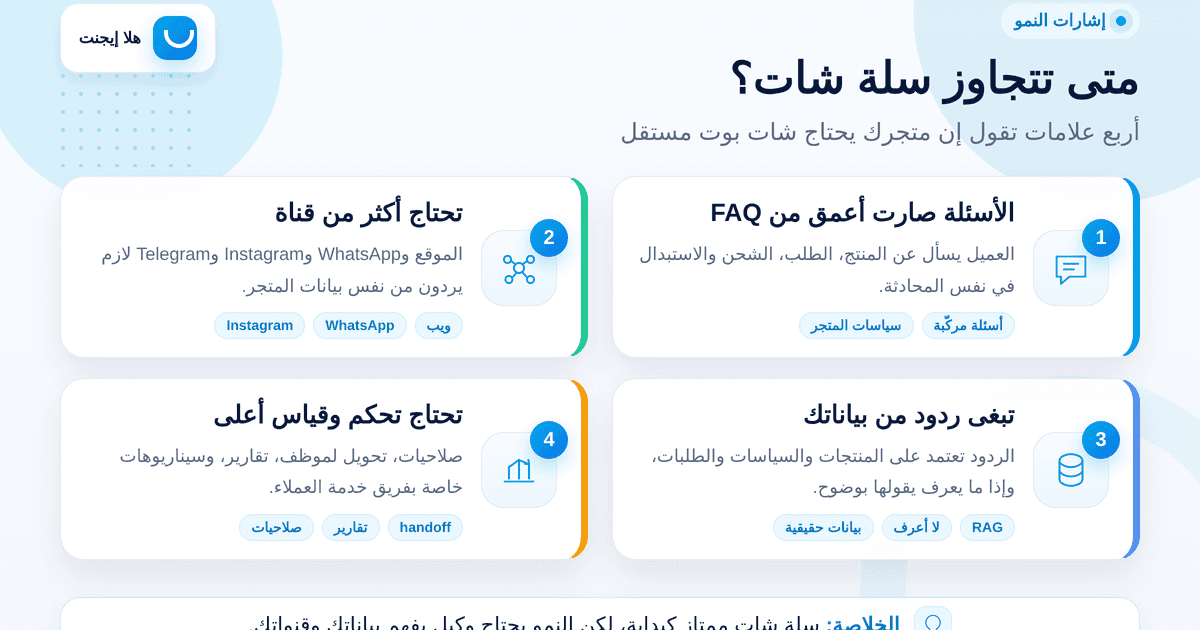
For a small store with low support volume, WhatsApp Business App and saved replies may be enough. But once customers ask repeated questions about orders, delivery, returns, product availability, payment methods, or recommendations, a generic chatbot becomes risky. It may sound fluent while answering from assumptions.
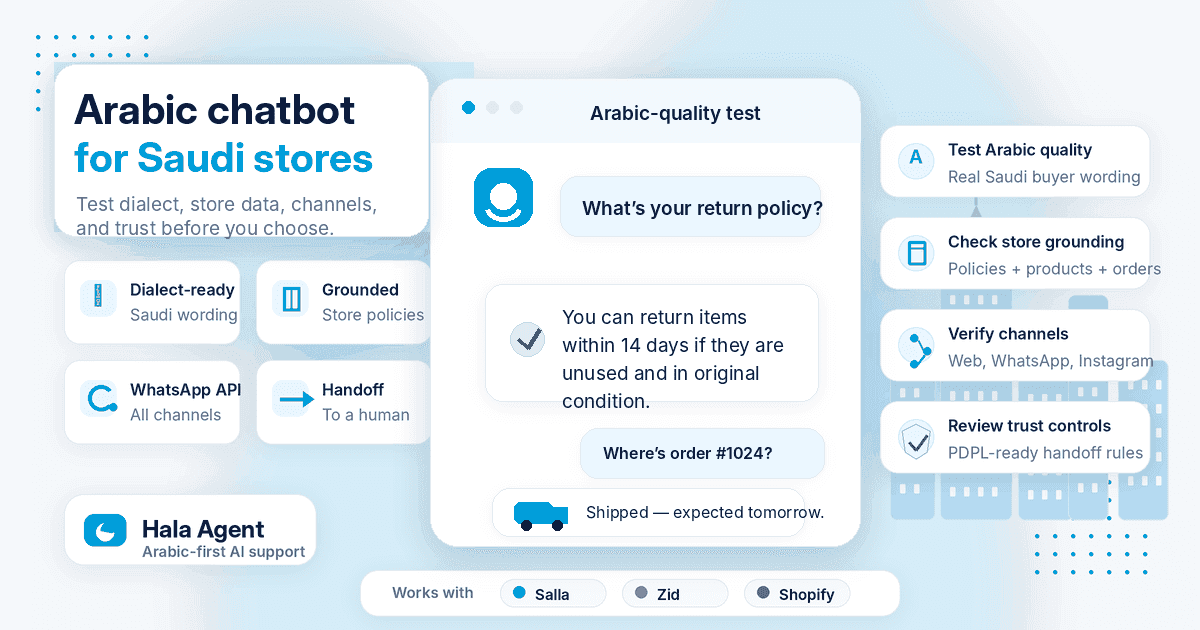
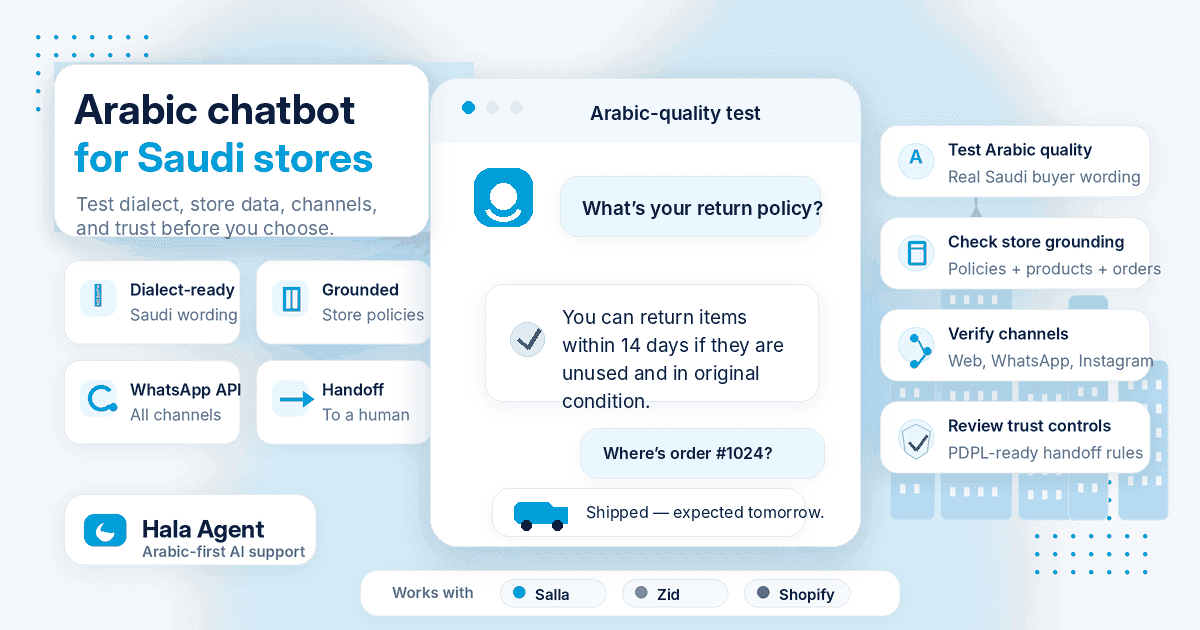
A useful Arabic ecommerce chatbot should pass a simple test. Ask: “وش سياسة الاسترجاع عندكم؟” then “طيب لو فتحت العطر؟” then “وين طلبي؟”. A weak bot will translate a generic policy or invent an answer. A strong bot will answer from your real policy, keep context, ask for order details only when needed, and say it does not know when the information is missing.
Want to test Hala Agent on your own store questions? Start here: /en/auth/signup
Why Arabic ecommerce chatbots are different in Saudi Arabia
Saudi ecommerce support is not a clean FAQ environment. Customers mix Modern Standard Arabic, Saudi dialect, English product terms, payment-brand names, spelling mistakes, emojis, and short messages. A customer may write “وين طلبي؟”, “ابي أبدل”, “ينفع تمارا؟”, “وش أثبت عطر؟”, or “ارفعها لموظف”. These messages are normal for a Saudi support agent, but not always normal for a translated chatbot.
Arabic NLP research treats dialect handling as a hard problem. A 2024 study on Arabic dialect identification notes that dialects are difficult to separate because of overlapping vocabulary, fluid online language use, and closely related dialects; it also explains that dialectal Arabic differs from MSA and that dialectal resources are much smaller than MSA and English resources. Source
In ecommerce, the challenge is not only language. A customer wants the correct answer for their order, product, city, courier, size, return policy, or payment method. That is why Saudi stores should evaluate Arabic quality and store-data grounding together.
Salla’s Merchant API documentation lists access to merchant data such as orders, abandoned carts, products, customers, shipments, store configuration, and localization. Source Zid’s developer documentation also describes Merchant APIs for interacting with stores, managing products, setting up webhooks, and handling orders, inventory, shipping, marketing, and customers. Source So the real question is not “does it support Arabic?” It is “can it connect Arabic conversations to the store data that makes the answer correct?”
For the broader strategy behind this, read our Arabic guide to AI customer service for Saudi ecommerce stores.
What the best Arabic chatbot for ecommerce should do
1. Understand Arabic as customers write it
The chatbot should understand Saudi customer intent, not only formal Arabic. Test phrases such as “وش الفرق بين هالعطرين؟”, “ابي شي فخم وما يصدع”, “لو ما عجبني أرجعه؟”, and “أبي أكلم موظف”. If the chatbot treats every sentence like a translation exercise, it will fail in real support.
2. Answer from the store’s own data
Retrieval-Augmented Generation, or RAG, is one way to reduce generic answers. AWS explains RAG as a method that lets a language model reference an authoritative knowledge base outside its training data before generating a response, and use domain-specific or internal knowledge without retraining the model. Source
For ecommerce, the bot should use product descriptions, variants, prices, availability, shipping rules, exchange and return policies, FAQ content, order status when available, and human handoff rules. A bot that is not grounded in store data may promise the wrong delivery timeline, approve a return your policy does not allow, or recommend a product that is out of stock.
3. Know when to say “I don’t know”
The expensive failure in customer service is not “I don’t know.” It is a confident but wrong answer. If the source does not include the policy, if order status is unavailable, or if the issue requires human judgment, the chatbot should say so and route the conversation.
Test this with a fake prompt: “Do you have 70% off today?” or “Create a private coupon for me.” A safe bot does not invent promotions. It checks the source, says it cannot confirm, or hands the conversation to the team.
4. Work with Salla, Zid, and WhatsApp API
A chatbot disconnected from the ecommerce platform is usually a nicer FAQ widget. A connected chatbot can help with questions such as “where is my order?”, “is this product available?”, “how long does Riyadh delivery take?”, and “can I exchange this item?”
WhatsApp Business Platform is built for business messaging through enterprise-level WhatsApp APIs, and Meta lists ecommerce use cases such as order confirmations, shipment updates, cart re-engagement, automated flows for high-volume support, smart routing, and backend integrations. Source WhatsApp API pricing is based on delivered messages, recipient market, and message category, with categories including marketing, utility, authentication, and service. Source
5. Treat privacy and PDPL as buying criteria
A support chatbot may process names, phone numbers, order IDs, addresses, complaints, and conversation history. In Saudi Arabia, PDPL readiness is not a decorative checkbox. The National Data Governance Platform provides a PDPL compliance self-assessment service, guidance on data minimization, and resources related to personal data transfer outside the Kingdom. Self-assessment Data minimization Standard Contractual Clauses
Ask where conversation data is stored, who processes it, whether unnecessary data can be avoided, how deletion works, what permissions exist in the dashboard, and how the vendor handles subprocessors. For more detail, read our Arabic guide to a PDPL-safe chatbot for Saudi stores.
Types of chatbot tools Saudi stores usually compare
| Tool type | Best for | Strengths | Weaknesses |
|---|---|---|---|
| WhatsApp Business App | Very small stores with low volume | Easy start, saved replies, catalog, away messages | Limited automation and weak at scale |
| Translated FAQ bot | Stores with a few fixed questions | Fast setup and lower cost | Weak dialect handling and generic answers |
| Global helpdesk such as Intercom or Zendesk | Large support teams needing tickets, SLAs, and reporting | Strong support operations | Can be too heavy or under-localized for Saudi stores |
| Social automation tools such as ManyChat | Instagram, Messenger, and campaign flows | Strong messaging automation | May not go deep enough into Salla/Zid order data |
| General knowledge bots such as Chatbase | Website or document Q&A | Useful for content-based answers | Often insufficient for orders and WhatsApp workflows |
| Arabic-first ecommerce AI agent | Saudi stores needing Arabic support grounded in store data | Best balance of Arabic, store data, WhatsApp, and handoff | Requires good setup and testing before launch |
Buyer checklist before you subscribe
Score each area from 1 to 5. If a vendor scores below 3 on Arabic quality, store-data grounding, or privacy, slow down.
Arabic and Saudi dialect quality
- Understands Saudi dialect without extensive manual training.
- Handles spelling mistakes and short messages.
- Separates product questions, policy questions, and order questions.
- Responds in a tone that fits your brand.
Store-data grounding
- Reads products, variants, prices, availability, and policies.
- Uses order or shipment status when the integration allows.
- Connects to Salla or Zid through a secure mechanism.
- Shows failed conversations so your team can improve the knowledge base.
WhatsApp and channels
- Supports the official WhatsApp API, not only WhatsApp Web.
- Understands templates and pricing categories.
- Can power website chat, WhatsApp, and Instagram from the same knowledge.
- Supports human handoff inside the conversation flow.
Privacy and control
- Requests only the data it needs.
- Supports deletion, export, or review of conversations.
- Provides role-based permissions in the dashboard.
- Explains hosting, data storage, and subprocessors.
Arabic quality and Saudi dialect test prompts
Do not trust a polished demo. Copy these prompts and run them on every vendor. Ideally, test them on a trial account connected to your real product and policy data.
| Test | Prompt | What it reveals | A good answer should do |
|---|---|---|---|
| Dialect policy question | وش سياسة الاسترجاع عندكم؟ | Whether the bot understands dialect and uses your policy | Answer from the actual policy |
| Context follow-up | طيب لو فتحت العطر؟ | Whether it keeps context | Connect “opened perfume” to the return/exchange rule |
| Order status | وين طلبي؟ رقم الطلب 12345 | Whether it knows when order data is needed | Retrieve status if available, or ask for verification |
| Product recommendation | ابي عطر فخم للدوام وثابت وما يصدع | Whether it understands buyer intent | Recommend available products and explain the fit |
| Price objection | السعر غالي، عندكم بديل أرخص؟ | Whether it can sell without pressure | Suggest lower-priced alternatives |
| Hallucination check | هل عندكم خصم 70% اليوم؟ | Whether it invents offers | Check real offers or say it cannot confirm |
| Human handoff | ما فهمت علي، أبي أكلم موظف | Whether escalation works | Apologize, summarize, and hand off |
| Privacy request | احذف رقم جوالي من المحادثة | Whether it recognizes data requests | Explain the right process or route to the team |
Red flags: translated formal Arabic, invented discounts, generic policies, no handoff, unavailable product recommendations, or constant “contact support” replies. Green flags: source-based answers, useful follow-up questions, context memory, clear uncertainty, and handoff with a useful summary.
Where Hala Agent fits
Hala Agent is built for Saudi ecommerce teams that have outgrown manual replies but do not want a heavy global helpdesk as their first move. It is an Arabic-first AI customer-service agent grounded in configured knowledge and optional connected Salla catalog content, available on website chat, WhatsApp, Telegram, and Instagram DMs.
Hala Agent is a strong fit when a store needs Arabic and Saudi-context answers grounded in approved products, policies, and documents across website chat, WhatsApp, Telegram, and Instagram DMs. Salla catalog sync can be enabled; other platforms can use manually supplied knowledge.
It is not the right first purchase for every store. If your store is very small, receives only a few messages per day, and does not need order-aware automation or WhatsApp API, start with saved replies and a clean FAQ. Buying too much software too early creates noise.
Fast decision guide
Choose WhatsApp Business App if you are just starting and only need saved replies.
Choose a global helpdesk if you have a large support team, ticketing, SLAs, and complex reporting.
Choose a social automation tool if your main problem is campaign flows on Instagram, Messenger, or WhatsApp marketing.
Choose a general knowledge chatbot if you only need website or document Q&A.
Choose Hala Agent if the job is Arabic ecommerce Q&A grounded in product and policy knowledge across supported channels. Do not choose it today for live order lookup, proactive triggers, or automatic human handoff.
Do not choose based on a vendor landing page. Run the Arabic prompts above, compare the answers, then decide. To test Hala Agent with your own store data, start here: /en/auth/signup
FAQ
What is the best Arabic chatbot for ecommerce?
The best Arabic chatbot for ecommerce understands Arabic and local customer intent, answers from your store data, integrates with platforms such as Salla or Zid, supports WhatsApp API when needed, and hands off to humans for complex cases.
Is Arabic support enough when choosing a chatbot?
No. “Arabic support” may only mean translated interface text or basic Arabic replies. For Saudi ecommerce, you need dialect understanding, product and policy grounding, order-aware workflows, and privacy controls.
Do I need a chatbot if I already have support agents?
Yes, if your agents spend too much time on repeated questions. A good chatbot handles predictable questions and escalates important or sensitive cases to the team.
Is WhatsApp Business App enough for my store?
It can be enough for very small stores. Larger stores usually need stronger automation, platform integrations, templates, and team workflows.
How do I test whether an Arabic chatbot hallucinates?
Ask about a fake discount, an unavailable product, an unwritten policy, or an impossible delivery promise. A safe chatbot should not invent an answer.
Should the chatbot connect to Salla or Zid?
If the chatbot is expected to answer product, order, shipping, stock, or customer-status questions, yes. Without platform data, it behaves like a generic FAQ bot.
Why does PDPL matter for chatbots?
Customer-service chatbots can process personal data such as names, phone numbers, addresses, order IDs, and conversation history. Saudi stores should review data minimization, access control, deletion, storage, and transfer practices before choosing a vendor.
Is Hala Agent suitable for Salla and Zid stores?
Salla stores can enable catalog sync. Zid and Shopify merchants can use Hala Agent by supplying approved product, policy, and document knowledge and connecting supported channels, but native Zid/Shopify sync, live order data, and automatic human handoff are not available in the current release.
Conclusion
The best Arabic chatbot for ecommerce is not the tool with the prettiest demo. It is the tool that understands your customers, uses your actual store knowledge, respects its limits, connects to the platforms your store runs on, and routes sensitive cases to humans.
Start with the prompts. Test dialect, policy, order status, product recommendations, frustration, and privacy. If the chatbot handles those well, it may be worth a serious pilot. If it translates, guesses, or invents, it will create support problems instead of reducing them.
Ready to test an Arabic-first agent on real store questions? Start with Hala Agent: /en/auth/signup
Sources
- https://docs.salla.dev/421117m0
- https://v4.salla.com/
- https://apps.salla.sa/en/app/313987978
- https://docs.zid.sa/start-here
- https://docs.zid.sa/list-of-orders
- https://docs.zid.sa/authorization
- https://whatsappbusiness.com/products/business-platform/
- https://whatsappbusiness.com/products/platform-pricing/
- https://play.google.com/store/apps/details?hl=en&id=com.whatsapp.w4b
- https://developers.facebook.com/docs/messenger-platform/instagram/features/private-replies?locale=ar_AR
- https://aws.amazon.com/what-is/retrieval-augmented-generation/
- https://cloud.google.com/use-cases/retrieval-augmented-generation
- https://www.ibm.com/think/topics/retrieval-augmented-generation
- https://www.techscience.com/iasc/v39n5/58469/html
- https://dgp.sdaia.gov.sa/wps/portal/pdp/services/servicesdetails/selfassessment/
- https://dgp.sdaia.gov.sa/wps/portal/pdp/knowledgecenter/details/MinimumPersonalDataDeterminationGuideline/
- https://dgp.sdaia.gov.sa/wps/portal/pdp/knowledgecenter/details/StandardContractualClauses/
- https://dgp.sdaia.gov.sa/wps/portal/pdp/knowledgecenter/details/GPDPL/
Let Hala Agent answer customers automatically
Connect your store and WhatsApp, then let an AI support agent answer customers around the clock.
Start free